
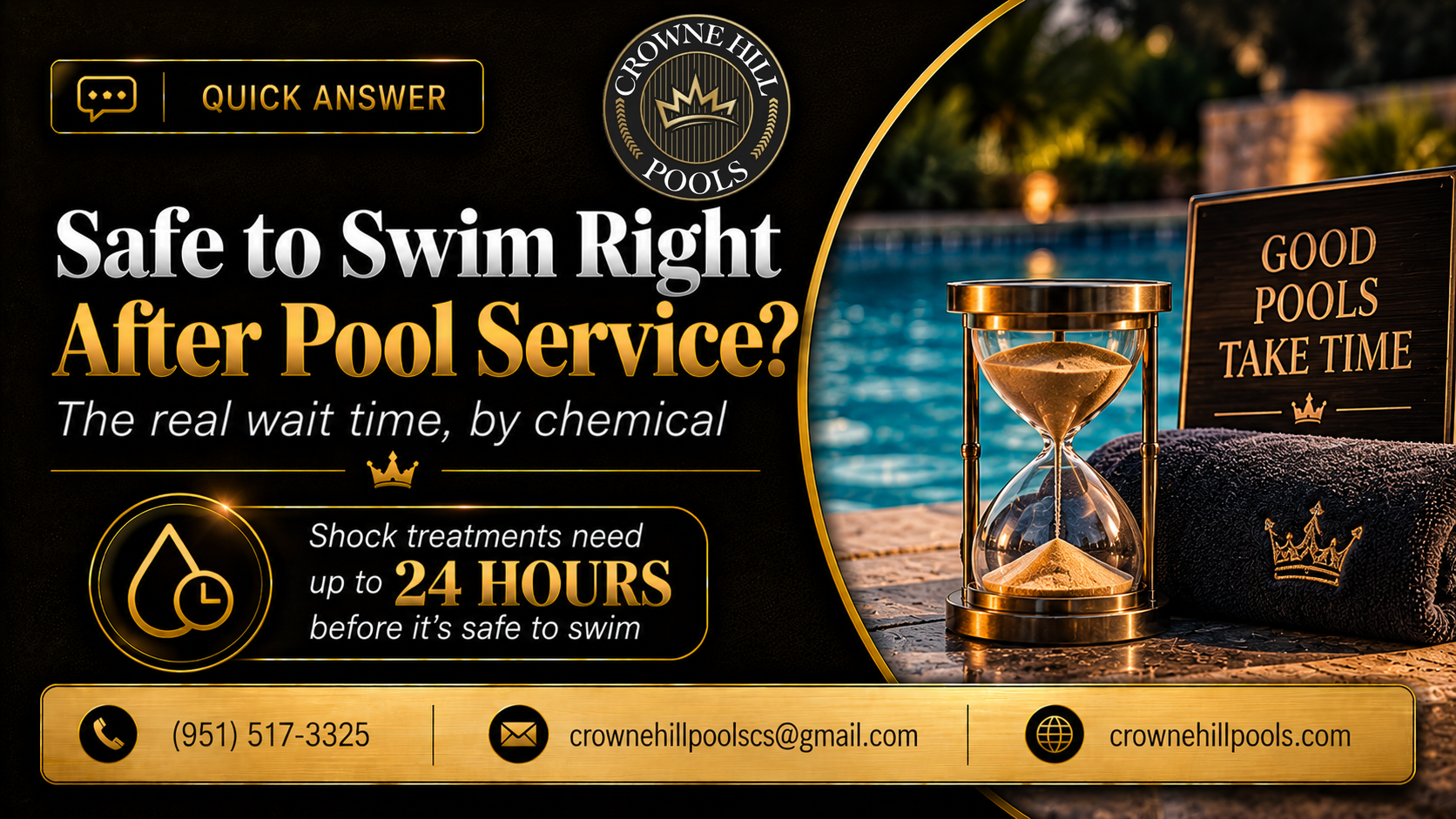
It’s a fair question to ask before anyone jumps in: did the tech just add something that needs time to work before it’s safe? Pool Chemical Wait Time isn’t one universal number — the honest answer depends entirely on what happened during that visit, and most routine service calls are far less restrictive than people assume.
Pool Chemical Wait Time: The Quick Answer
After a routine service visit — testing and adjusting pH, alkalinity, and a standard chlorine dose — most pools are safe to swim in within 20 to 30 minutes, once the pump has circulated the water. If your technician shocked the pool, the wait is longer: 8 to 24 hours, until free chlorine tests back down to 1–4 ppm, is the standard rule for chlorine-based shock. Non-chlorine shock is the exception, usually needing only 15 to 30 minutes.
Wait Times by Chemical Type
Different chemicals need different amounts of time to fully disperse and drop to a swimmer-safe level. Pool Chemical Wait Time varies more than most homeowners expect:
| Chemical | Typical Wait Time |
|---|---|
| pH / alkalinity balancers | 20–30 minutes |
| Algaecide | 15–30 minutes |
| Clarifier | 20 minutes–1 hour |
| Chlorine tablets (dispenser/floater) | No wait |
| Liquid or granular chlorine (routine dose) | 20 minutes–4 hours |
| Muriatic acid | 30 minutes–a few hours |
| Calcium hardness increaser | 2–4 hours |
| Chlorine-based shock | 8–24 hours (up to 48–72 for a heavy algae dose) |
| Non-chlorine shock | 15–30 minutes |
These are starting points, not guarantees — always defer to the wait time on the product label if it’s longer, and confirm with a test strip rather than a clock alone. Pump circulation matters just as much as time; a chemical that hasn’t fully mixed through the water can leave concentrated pockets well past the listed wait, regardless of how long you waited.
Why the Wait Matters
Swimming too soon after a chemical addition isn’t just an overcautious rule — it’s a real irritation and safety risk. High chlorine concentrations from a fresh shock treatment can cause skin and eye irritation, redness, and in more extreme cases, respiratory discomfort. Muriatic acid and other pH adjusters carry a similar risk if the water hasn’t had time to circulate and dilute — the same chemistry swings covered in our guide on why pool pH won’t stay balanced, since a pool that needs frequent acid corrections also means Pool Chemical Wait Time comes up more often than it should.
The CDC’s healthy and safe swimming guidance treats correctly balanced sanitizer levels as one of the basic protections against both recreational water illness and chemical injury — which cuts both ways: too little sanitizer is a health risk, and so is stepping into water where levels are still spiking from a recent treatment.
Did Your Technician Shock the Pool? Here’s How to Tell
A routine visit — the kind most pools get weekly — usually just means testing and lightly adjusting chlorine, pH, and alkalinity, plus skimming and vacuuming. That’s the fast, 20-to-30-minute-wait scenario. Shock treatment is a separate, occasional step usually reserved for heavy bather loads, after a rainstorm, or when algae is present — which is exactly the kind of situation covered in our guides on why pools go cloudy after shocking and fixing a pool that’s turned green overnight.
The most reliable way to know which one happened during your visit is to check the written service report a professional technician should leave behind — it should note exactly what was added and at what dose, rather than leaving you to guess. If you’re unsure, a quick chlorine test before letting kids or pets in the water is always worth the two minutes it takes, especially if you’re weighing pool safety for families and pets against a service schedule you don’t fully control.
Getting the Balance Right the First Time
A lot of Pool Chemical Wait Time confusion traces back to inconsistent dosing — a pool that’s chronically low on chlorine needs bigger corrective doses more often, which means more frequent longer waits. Keeping levels steady with the right sanitizer method in the first place, whether that’s liquid chlorine, tablets, or a salt system, reduces how often a big dose — and a long wait — is needed at all. The Pool & Hot Tub Alliance treats consistent, moderate dosing as more effective long-term than large, infrequent corrections, which lines up with what most service technicians see in practice.
FAQ: Pool Chemical Wait Time
How long after pool service can you swim? For a routine visit with standard chemical adjustments, 20 to 30 minutes after the pump has circulated the water is typically enough. If the pool was shocked, wait 8 to 24 hours and confirm free chlorine has dropped to 1–4 ppm.
How long after shocking a pool can you swim? At least 8 hours for a standard chlorine-based shock, and up to 24 to 72 hours for a heavy algae treatment. Non-chlorine shock only requires about 15 to 30 minutes.
Can I swim right after chlorine tablets are added? Yes. Tablets in a floater or dispenser dissolve slowly and don’t spike chlorine the way liquid or granular chlorine can, so there’s no meaningful wait required.
What happens if you swim too soon after pool chemicals? Possible skin and eye irritation, redness, and in more extreme chlorine or acid exposure, respiratory discomfort or chemical burns. Testing before swimming is the safest way to avoid it.
At Crowne Hill Pool Services, every visit covers the full list — cleaning, chemistry, equipment, and a written service report. No shortcuts. No surprises.
📞 (951) 517-3325 | Crownehillpoolscs@gmail.com | Mon–Fri 8AM–5PM Serving Temecula, Murrieta, Menifee, French Valley, Winchester, Wildomar & surrounding areas.


