
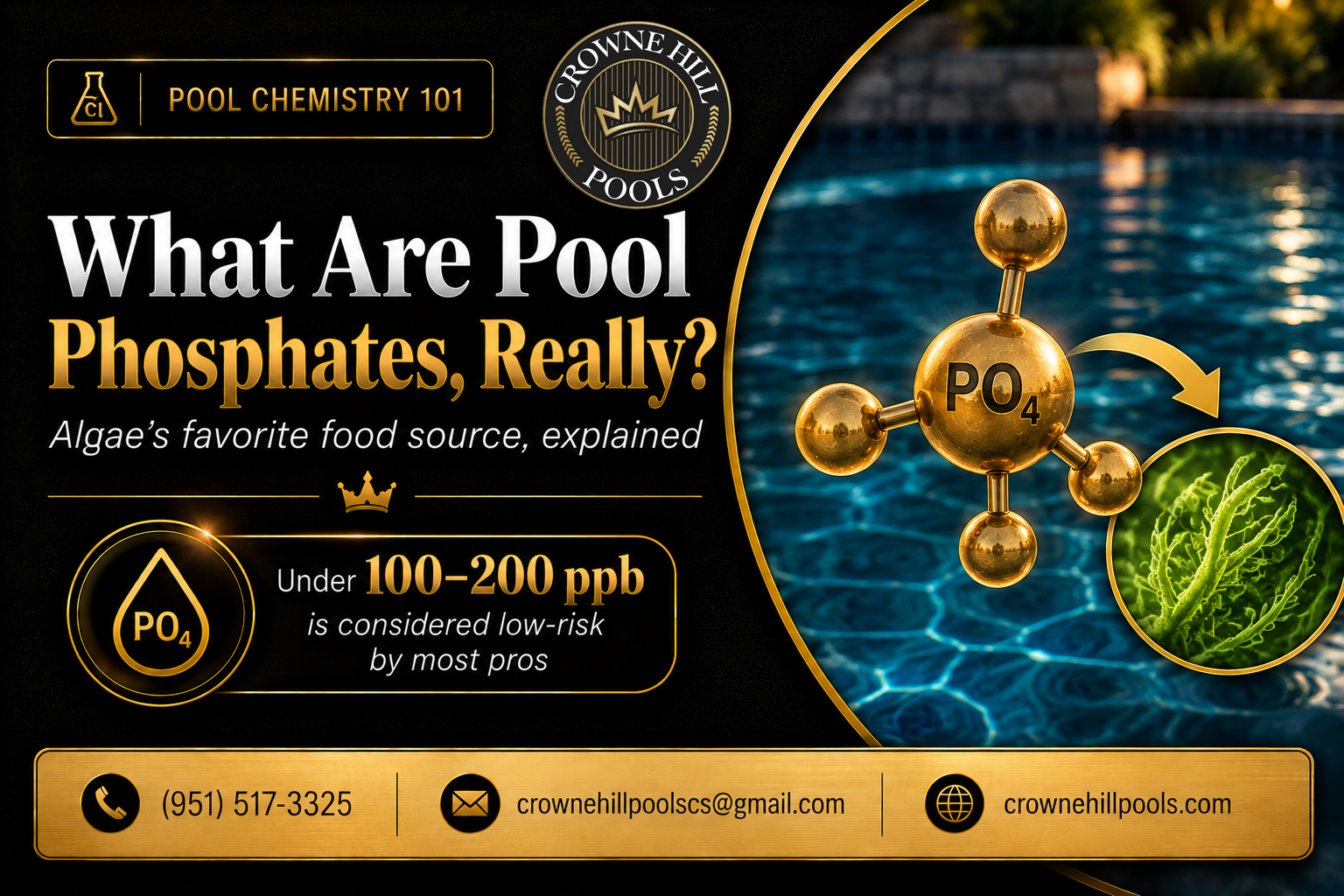
If you’ve ever had a pool store test your water and come back with a warning about “high phosphates,” you’ve probably also wondered whether that’s a real problem or just a reason to sell you another bottle of chemical. It’s a fair question — phosphates are one of the most misunderstood numbers in pool chemistry. Pool Phosphates Temecula pools build up matter, but not in the way most people assume.
Here’s what phosphates actually are, why they matter for algae control, and what level is genuinely worth doing something about.
Pool Phosphates Temecula: The Quick Answer
Phosphates are a nutrient that algae feed on, not a direct cause of algae growth — a pool with high phosphates and strong, consistent chlorine can stay perfectly clear. The risk shows up when chlorine drops from heat, rain, or heavy pool use: at that point, high phosphate levels let algae recover faster and grow more aggressively than it would in phosphate-free water. Most pool professionals treat anything under 100 to 200 parts per billion (ppb) as low-risk, with levels above 500 to 1,000 ppb worth addressing before summer heat or a busy pool season arrives.
What Are Phosphates, and Where Do They Come From?
Phosphates enter pool water constantly, from sources most homeowners never think about: decomposing leaves and pollen, fertilizer runoff from nearby landscaping, rainwater, sunscreen and body oils from swimmers, and even the tap water used to fill and top off the pool. Pool Phosphates Temecula homeowners deal with tend to climb faster than in milder climates — dry landscaping, seasonal Santa Ana winds carrying debris, and heavy pool use through a long summer all add up unless something is actively removing them.
Phosphates are measured in parts per billion (ppb), not parts per million (ppm) like chlorine or pH — a detail that trips up a lot of pool owners reading a test strip for the first time, since the scale is a thousand times smaller.
Do Phosphates Actually Cause Algae?
Not directly, and this is where a lot of pool-store advice oversimplifies things. Managing Pool Phosphates Temecula pools accumulate comes down to understanding that phosphates are food for algae, not the trigger that starts an outbreak. A pool with properly maintained chlorine relative to its cyanuric acid (stabilizer) level can carry a high phosphate count and never turn green, because there’s no algae surviving long enough to use that food source.
The real risk is compounding: once chlorine dips — after a heat wave, a rainstorm, or a stretch of heavy swimmer traffic — high phosphate levels give any surviving algae spores a much bigger head start. Algae multiplies faster, resists chlorine and algaecide more stubbornly, and rebounds harder after treatment. That’s usually the honest answer to “why does my pool keep getting algae” even after a shock treatment seemed to work: chlorine cleared the bloom, but the phosphate load made it easy for a new one to start the moment sanitizer levels slipped again.
What Counts as a High Phosphate Level
Guidance varies slightly across pool professionals, but the general ranges most technicians work from are:
| Phosphate Level (ppb) | Risk Level | Action |
| 0–100 | Low | No action needed |
| 100–300 | Moderate | Monitor, especially before summer |
| 300–500 | Elevated | Consider a phosphate remover |
| 500–1,000 | High | Treat before heavy heat or use |
| 1,000+ | Very high | Treat promptly, possibly with a partial drain |
There’s no single universal “emergency” number — a well-chlorinated pool at 800 ppb can stay clearer than a poorly maintained one at 200 ppb. Phosphate level is one factor among several, not a standalone verdict on a pool’s health.
How to Test for Phosphates
Standard chlorine and pH test strips don’t measure phosphates — it requires a dedicated phosphate test kit, since the readings are in ppb rather than ppm. Testing Pool Phosphates Temecula pools at the start of summer and again mid-season is a reasonable baseline, since levels tend to climb through the season as debris, sunscreen, and top-off water accumulate.
How to Lower Phosphate Levels in a Pool
A phosphate remover (usually a lanthanum-based product) binds phosphates into a form the filter can capture and remove from the water, typically over 24 to 48 hours with continuous filtration. For very high levels — above roughly 2,000 ppb — a partial drain and refill before treatment is often more practical than trying to chemically remove that much phosphate in one pass, similar to the reset-and-rebalance approach covered in our guide on fixing a pool that’s turned green overnight.
Prevention matters more than reactive treatment. Keeping leaves and organic debris out of the water, emptying skimmer and pump baskets regularly, and maintaining strong circulation all slow the rate phosphates build up in the first place — the same fundamentals covered in our guide to why pools go cloudy after shocking and how heat waves affect pool chemistry, since phosphates and chlorine demand tend to rise together during Temecula’s hottest stretch.
Chlorine type matters here too — our comparison of liquid chlorine vs. tablets vs. salt covers how each sanitizing method holds up when phosphate and organic load climb through the season. And if your pool’s pH keeps drifting out of range at the same time phosphates are creeping up, both problems often trace back to the same root cause: inconsistent circulation or chemical dosing.
The Pool & Hot Tub Alliance and CDC’s healthy swimming guidance both treat consistent sanitizer levels — not any single secondary chemical like phosphate — as the primary defense against algae and recreational water illness. Phosphate control is a supporting factor, not a replacement for keeping chlorine where it needs to be.
FAQ: Pool Phosphates Temecula Homeowners Ask
Why does my pool keep getting algae even after I shock it? High phosphate levels are a common reason. Shocking kills the current algae bloom, but if phosphates remain high, any new spores that land in the water have an easy food source and can bloom again quickly once chlorine levels dip.
What does a phosphate remover actually do? It binds dissolved phosphates into particles the filter can capture and remove from the water, typically over 24 to 48 hours of continuous filtration. It doesn’t kill algae directly — it removes algae’s food source.
Do I need to worry about phosphates if my pool always looks clear? Not urgently. Managing Pool Phosphates Temecula homeowners deal with matters most when chlorine is inconsistent — a pool that stays consistently clear with stable chlorine levels is managing algae risk successfully regardless of phosphate count.
Can tap water raise phosphate levels on its own? Yes. Some municipal water supplies carry a meaningful phosphate load, so refilling or topping off a pool can raise levels even without any new debris or fertilizer runoff.
At Crowne Hill Pool Services, every visit covers the full list — cleaning, chemistry, equipment, and a written service report. No shortcuts. No surprises.
📞 (951) 517-3325 | Crownehillpoolscs@gmail.com | Mon–Fri 8AM–5PM Serving Temecula, Murrieta, Menifee, French Valley, Winchester, Wildomar & surrounding areas.


