
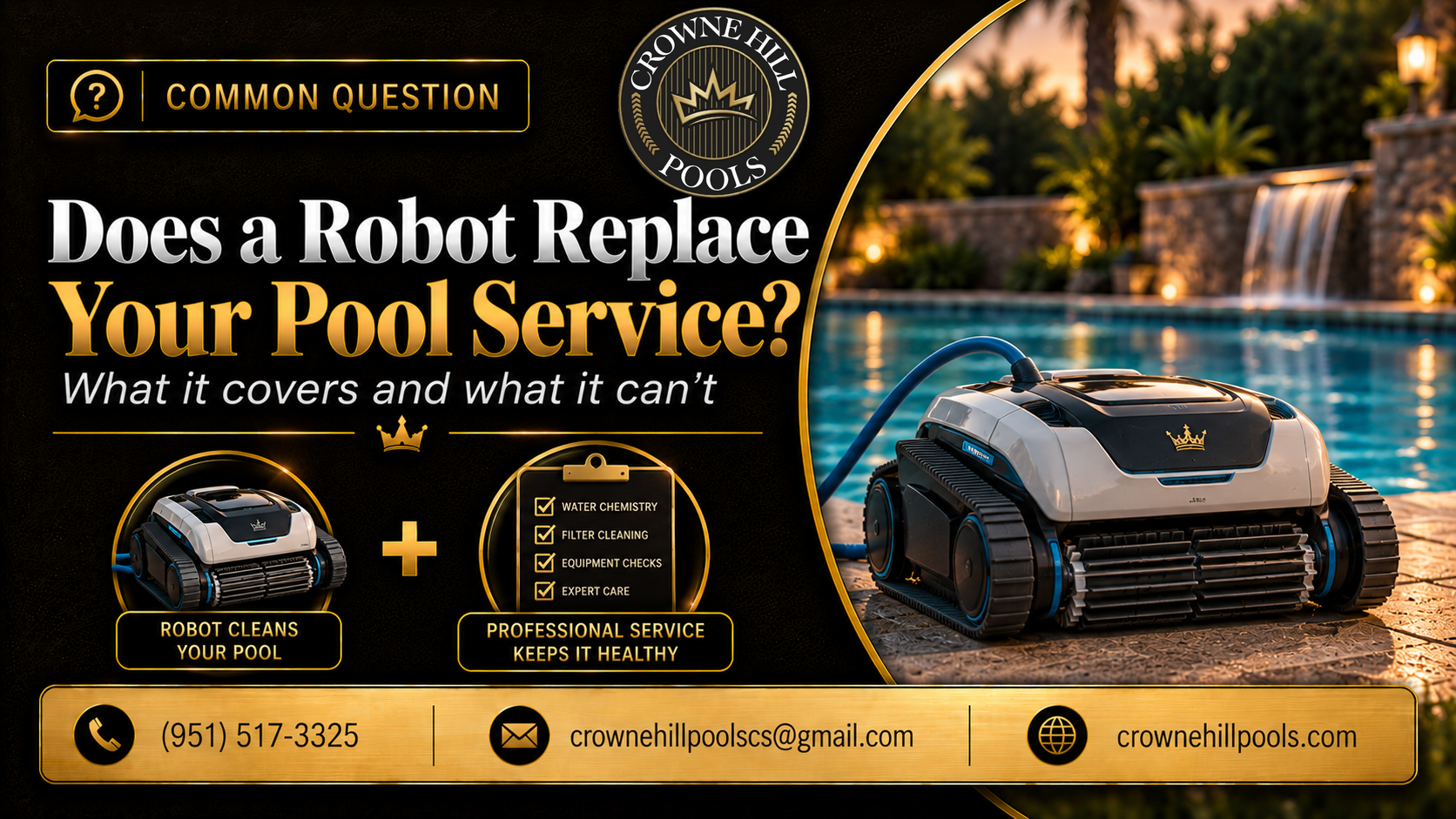
A good robotic cleaner is genuinely impressive — it scrubs the floor, climbs the walls, and picks up debris while you do something else entirely. It’s also the source of one of the most common questions we hear from homeowners weighing Robotic Pool Cleaner Maintenance against their current setup: if the robot handles the cleaning, do you still need a pool service?
Robotic Pool Cleaner Maintenance: The Quick Answer
No — a robotic cleaner replaces the physical scrubbing and vacuuming part of a service visit, but it doesn’t test or balance water chemistry, check your pump and filter, or catch equipment problems before they become expensive ones. Most homeowners who own one still benefit from periodic professional service, just often at a lighter frequency than they’d need without a robot.
What a Robotic Pool Cleaner Actually Does
A robotic cleaner is a self-contained unit with its own motor, intake, and filter — you drop it in, it runs its cycle, and you pull it out when it’s done. It vacuums the floor, brushes the walls, and picks up fine debris along the waterline, all without adding any extra strain to your pool’s main pump or filtration system. Most models finish a full cycle in a couple of hours and can run as often as you’d like, which is more consistent than a once-a-week manual clean.
What It Doesn’t Do (and Why That Still Matters)
This is where Robotic Pool Cleaner Maintenance conversations usually run into a gap. A robot doesn’t test pH, chlorine, or alkalinity, doesn’t add chemicals, and can’t diagnose a struggling pump or a clogged filter. It also won’t fix a pool that’s already gone green or cloudy — that’s a chemistry problem, not a debris problem, and no amount of vacuuming resolves it on its own. If your water has turned, our guide to fixing a pool that’s turned green overnight covers what actually needs to happen first.
A robot also can’t spot the kind of early warning signs a technician catches during a normal visit — a filter pressure creeping up, a pump starting to strain, a safety issue with a gate or drain cover. That’s the part of what a pool tech checks on every visit that a machine simply isn’t built to do.
Maintaining the Robot Itself
Robotic Pool Cleaner Maintenance isn’t just about what the robot does for your pool — the robot needs its own upkeep, too. Rinsing the filter basket after each cycle and letting it fully charge between runs keeps it working at full strength — a clogged filter cartridge on the robot itself is one of the most common reasons owners think their unit is “losing suction” when it’s really just due for a rinse. Brushes and tracks wear over time as well and typically need replacing every season or two depending on use.
So Do You Still Need Pool Service With a Robot?
For most homeowners, yes — just not necessarily at the same frequency. A robot covers the physical cleaning that used to eat up most of a weekly visit, which means service can often shift to water testing, chemical balancing, and equipment checks rather than routine scrubbing. That’s a meaningfully different visit than the one a robot-free pool needs, but it’s rarely a reason to skip service altogether, especially through a Temecula summer when chemistry needs closer attention than a robot alone can provide.
If you’re deciding between a robotic, suction, or pressure-side cleaner in the first place, our comparison of all three types breaks down which fits different pool layouts and budgets. And if you like the idea of automating more than just cleaning, pool automation systems and smart controllers can handle pump scheduling and heater control the same way a robot handles the floor — though none of it replaces a set of trained eyes on the equipment periodically.
The Pool & Hot Tub Alliance and CDC’s healthy swimming guidance both frame water safety as a combination of clean water, balanced chemistry, and properly functioning equipment — physical cleanliness is one piece of that picture, not the whole thing.
FAQ: Robotic Pool Cleaner Maintenance
Do I still need pool service if I have a robotic cleaner? Usually yes, though often less frequently. A robot handles debris and scrubbing; a technician still handles chemistry, equipment checks, and anything that needs a trained eye to catch early.
Can a robotic pool cleaner fix a green or cloudy pool? No. Green or cloudy water is a chemistry issue, and a robot only removes physical debris. It can help clean up settled dead algae after a chemical treatment, but it won’t resolve the underlying imbalance on its own.
How often should I clean my robotic pool cleaner’s filter? After every cycle for best performance. A clogged filter is one of the most common reasons owners assume their unit has lost suction when it just needs a rinse.
Is a robotic cleaner worth it if I already pay for pool service? It can be, especially for pools that collect debris quickly between visits. Good Robotic Pool Cleaner Maintenance habits — regular rinsing, periodic brush checks — pair well with keeping service for chemistry, equipment, and less frequent deep maintenance.
Ready to upgrade? We install and repair automation systems, salt chlorinators, lights and more. See our pool equipment installation service.
At Crowne Hill Pool Services, every visit covers the full list — cleaning, chemistry, equipment, and a written service report. No shortcuts. No surprises.
📞 (951) 517-3325 | Crownehillpoolscs@gmail.com | Mon–Fri 8AM–5PM Serving Temecula, Murrieta, Menifee, French Valley, Winchester, Wildomar & surrounding areas.


